
Most people who install or specify insulated glass units have a clear picture of the finished product. Fewer have a clear picture of what it takes to produce one. The glass manufacturing process behind an IG unit is a sequence of interdependent steps, and the finished unit's quality depends not on any single step but on how consistently each stage hands off to the next. Knowing that sequence helps explain why production discipline, equipment capability, and process control matter as much as raw material quality in determining what arrives on a job site.
Where IG Production Begins: Raw Glass Intake
Insulated glass manufacturing starts with flat glass supplied in large stock sheets from float glass producers. These sheets arrive at the IG fabricator in standard sizes and are inspected for surface defects, coating damage, and dimensional accuracy before entering the production sequence. At this stage, the glass manufacturing process sorts sheets by product type, coating, and thickness, then stages them for cutting according to the production schedule.
Coated glass, including Low-E products, requires careful handling because the coating surface is sensitive to contact and contamination. A defect introduced at the intake stage, whether a scratch, a fingerprint on a coated surface, or a handling chip on an edge, that passes inspection undetected will travel through every subsequent production step and appear in the finished unit.
Cutting and Sizing
Once staged for production, glass sheets move to the cutting station where they are scored and broken to the dimensions required for each unit in the production run. In automated glass manufacturing lines, software controls cutting and optimizes cut layouts across each sheet to minimize waste and maximize yield.
The cutting head scores the glass surface along the programmed path, then the sheet breaks along the score line using a controlled breaking mechanism. Dimensional accuracy at this stage directly affects spacer alignment, seal geometry, and unit fit in the receiving frame.
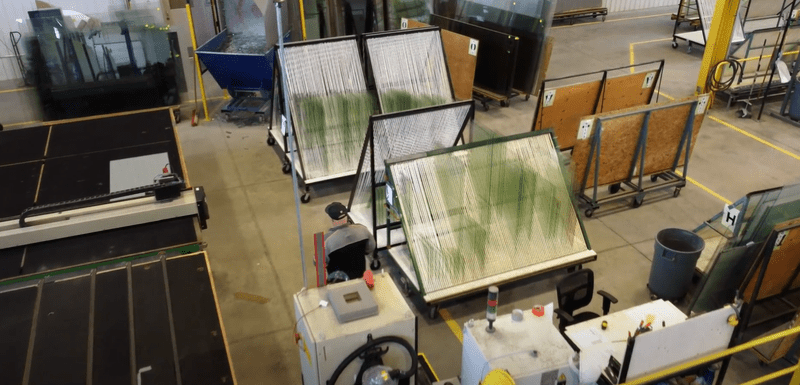
A pane cut even a few millimeters out of specification produces a unit that either fails to fit the opening or carries an uneven spacer reveal that weakens the perimeter seal.
Washing and Surface Preparation
Cut glass panes move through an automated washing station before any further processing. The washing step removes cutting fluid residue, glass particles, surface dust, and any contamination accumulated during handling.
Clean glass surfaces are essential for proper sealant adhesion at the unit's perimeter. A contaminated surface, even one that appears clean to the eye, compromises the bond between the primary sealant and the glass, creating a path for moisture infiltration over time.
The glass manufacturing process treats washing not as a housekeeping step but as a functional production requirement. Water quality, brush condition, drying efficiency, and line speed all affect the cleanliness of the glass surface exiting the washer, and quality-focused operations monitor each variable.
Spacer Bar Assembly and Application
The spacer bar defines the cavity between the two glass panes and carries the desiccant that absorbs residual moisture within the sealed unit. In automated IG production lines, spacer bars are bent to the required perimeter shape and then coated with the primary sealant, typically polyisobutylene, before being applied to one of the glass panes.
The primary sealant creates the first seal between the spacer and the glass surface, preventing moisture from entering the cavity at the spacer interface. Spacer placement must be precise and consistent around the full perimeter of the unit. An uneven reveal, where the spacer sits closer to the edge in some areas than others, creates weak points in the seal and affects the finished unit's appearance as seen through the frame.
Gas Filling
Units destined for argon or other gas fill enter a filling station after the spacer is applied and before the second pane is pressed into position. In automated glass manufacturing lines, the filling process displaces the air in the forming cavity with the fill gas through controlled injection. The gas concentration achieved during filling affects the thermal performance of the finished unit.
Argon, the most commonly used fill gas, improves the unit's insulating value by reducing convective heat transfer across the cavity compared to air. Fill concentration is typically verified during production using gas measurement equipment, and units that do not achieve the specified fill level are identified before sealing rather than after.
Pressing and Primary Seal Completion
Once the spacer is positioned and the gas fill is complete, the second glass pane is pressed onto the spacer assembly under controlled pressure. The pressing step compresses the primary sealant between the spacer and both glass surfaces, completing the first seal around the unit's full perimeter.
In automated IG lines, the pressing process is mechanically controlled to apply consistent pressure across the entire unit surface. Uneven pressing produces variable sealant compression that affects both the seal integrity and the dimensional consistency of the finished unit.
The gap width between the panes, which determines the cavity thickness and contributes to thermal performance, is also established at the pressing stage and must fall within the tolerance specified for the unit configuration.
Secondary Sealing
The secondary sealant, applied around the perimeter of the pressed unit, provides the structural bond that holds the unit together and the secondary moisture barrier that protects the primary seal over time. The most common secondary sealants in IG manufacturing are silicone and polyurethane, with the choice depending on the intended application and the frame system the unit will be installed into.
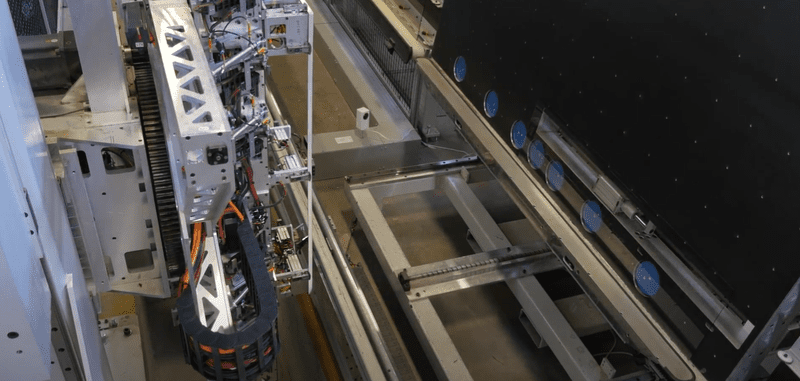
Silicone secondary sealant is standard for most applications and provides excellent long-term durability and UV resistance. The secondary sealant fills the full depth of the perimeter channel between the outer glass surfaces and the edge of the spacer. Incomplete or uneven secondary seal application leaves voids in the perimeter that allow moisture to reach the primary seal and accelerate unit failure.
Quality Inspection and Unit Handling
Finished units move through a final inspection stage before leaving the production line. Visual inspection checks for internal contamination, seal completeness, spacer alignment, and surface defects on both glass faces.
Dimensional verification confirms the finished unit meets the order's specified tolerances. Units that do not pass inspection are pulled from the production run before they reach packaging. Handling after inspection is as consequential as any production step.
An IG unit that passes inspection but is then stored incorrectly, transported without adequate edge protection, or installed without proper setting blocks can arrive at the job site damaged or perform below specification in service.
Glass Manufacturing at Insul-Lite Manufacturing™
A clear picture of the glass manufacturing process helps identify where production discipline separates a unit that performs as specified from one that fails early. At Insul-Lite Manufacturing™, our IG production line is built around automated process control and consistent quality standards at every stage, from raw glass intake through final inspection.
Specifying a sealed unit from a manufacturer whose production process is as well controlled as the product itself is the decision that protects a project long after installation is complete. Contact us today to discuss your IG unit requirements and get a quote from our team.